
According to a recent survey, half of respondents said they had become more conservative because of market volatility.[i] That reaction is understandable. When markets decline and headlines turn negative, reducing risk can feel like the safest response.
But volatility is not a flaw in investing. It is an inherent part of it.
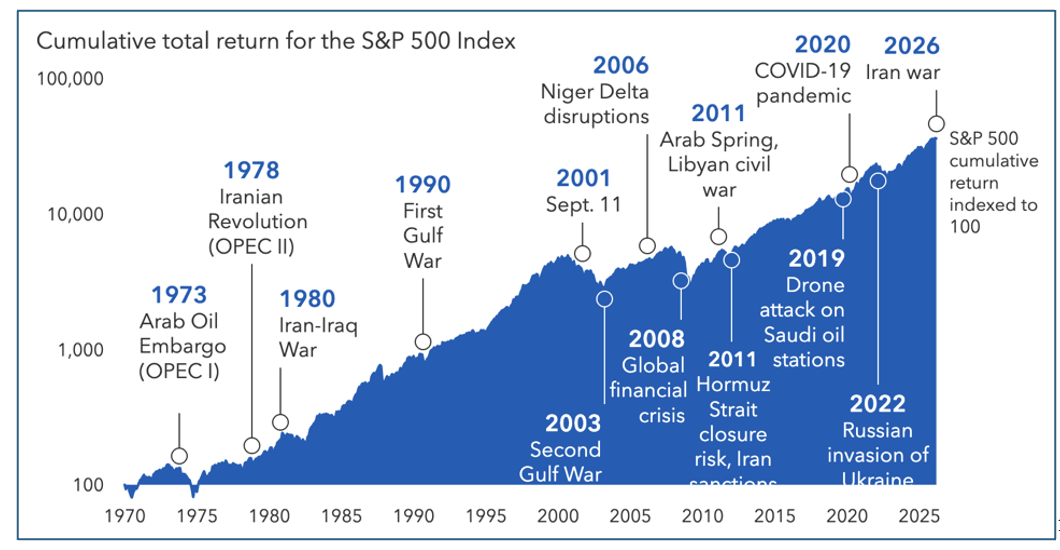
Every generation of investors has experienced wars, recessions, inflation, financial crises, and other events that created fear and uncertainty. Yet despite those disruptions, markets have continued to reward patient, long-term investors.
The Tradeoff
Every investment decision involves a tradeoff. Becoming more conservative may reduce short-term fluctuations, but it can also reduce your opportunity for long-term growth. A decision that provides comfort today may make it harder to reach your future goals.
That does not mean a portfolio should never change. Adjustments may be appropriate when your goals, time horizon, income needs, or circumstances change. But changing course simply because markets feel uncomfortable deserves careful consideration.
Volatility is temporary, but decisions made during volatile periods can have lasting consequences. Rather than trying to eliminate uncertainty, investors should consider both sides of the decision.
Reducing risk may provide short-term relief. Remaining committed to a thoughtful long-term strategy may offer something more valuable: a better opportunity to achieve the goals the portfolio was designed to support.
-Jonathan
©The Behavioral Finance Network. Used with permission. CRN0000000
[i] Source: Allianz Life. Q2 2026 Quarterly Market Perceptions Study
[ii] Sources: Capital Group, LSEG, Standard & Poor’s. As of 28 February 2026. Data is indexed to 100 as of 1 January 1970, based on cumulative total returns for the S&P 500 Index. Shown on a logarithmic scale. Event dates are aligned to the nearest observable market price. If an event occurs on a non‑trading day, the prior trading day is used as the start date. The Standard & Poor’s 500 Index is a capitalization weighted index of 500 stocks designed to measure performance of the broad domestic economy through changes in the aggregate market value of 500 stocks representing all major industries. All indices are unmanaged and may not be invested into directly. Past performance is no guarantee of future results.